
SEO for Manufacturers: Turning Engineering Specs into Qualified RFQs
We engineer manufacturing websites around engineering tolerances, material grades, ISO/AS9100/ITAR compliance, and CAD catalog indexation.
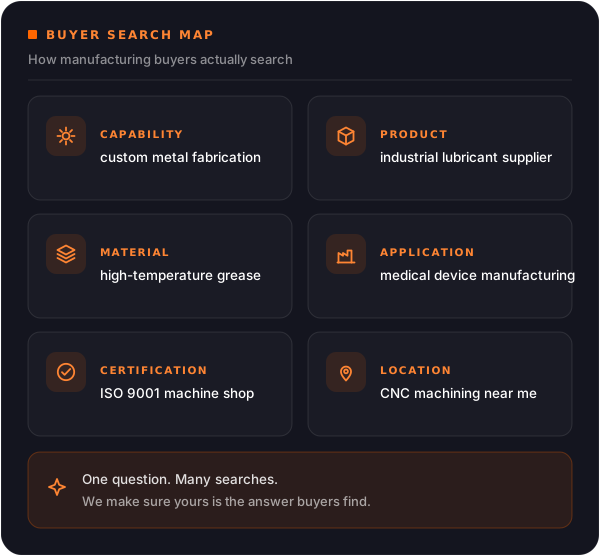
Procurement officers, design engineers, and supply chain directors do not search for 'manufacturing partners'. They search for specific capabilities, tolerances, materials, certifications, and volume capacities. When an aerospace engineer needs 'tight-tolerance 5-axis titanium CNC machining ISO 13485', they evaluate the few precision machine shops whose websites immediately prove technical capability and compliance.
Most manufacturing websites bury these details in unindexable downloadable PDF line cards or lump twenty distinct machining processes into a single generic 'Capabilities' page. We restructure industrial websites into high-performance technical discovery engines that win high-intent commercial searches across Google and AI-driven supplier research.
How buyers in Industrial & Contract Manufacturing search before choosing a partner
High-intent buyers rarely begin with brand names. They search through problem-aware, specification-driven, and comparison queries across Google, Maps, and generative AI engines.
The Line Card Trap: Why Technical Spec Sheets Stay Invisible
Industrial suppliers historically hosted technical cut sheets, equipment lists, and material tolerance charts as downloadable PDF attachments. While humans can download a PDF, real-time search crawlers and AI discovery bots struggle to parse multi-column spec tables embedded in complex PDF binaries under tight request budgets.
We extract your critical machinery models, maximum bed dimensions, working tolerances (+/- 0.0002"), and metallurgical grades (Inconel 718, 6061-T6, Nitronic 60) directly into server-rendered semantic HTML tables. This makes every machine, material, and tolerance immediately indexable and citable across search engines and generative procurement tools.
Architecting Dedicated Capability Hubs for Precision Engineering
Rather than listing all capabilities on a single overview page, we structure dedicated capability hubs for each primary manufacturing process: CNC milling, Swiss turning, wire EDM, sheet metal fabrication, and certified welding.
Each hub documents machine capabilities, secondary finishing processes (anodizing, passivating, heat treating), quality control instrumentation (CMMs, optical comparators), and regulatory compliance credentials. This provides the topical depth required to rank for high-value engineering queries.
ThomasNet, MacRAE's, and Industrial Knowledge Graph Concordance
Search engines verify manufacturing legitimacy through external industrial directories and federal registries. If your company name, CAGE code, DUNS number, or address varies across ThomasNet, MacRAE's Blue Book, and the SAM.gov federal registry, machine confidence drops.
We audit and synchronize your industrial entity across all primary manufacturing registries, linking your domain directly to your verified ISO 9001:2015, AS9100D, and ITAR registration credentials via Schema.org sameAs markup.
Optimizing the Long-Cycle Industrial RFQ Funnel
Industrial buyers rarely convert via instant checkout or simple contact forms. They need to submit 2D technical drawings, 3D CAD models (STEP/IGES files), annual volume estimates, and delivery timeline parameters.
We engineer high-converting RFQ intake architectures: supporting secure file uploads, non-disclosure agreement (NDA) initiation options, and clean CRM integration that routes inbound engineering drawings directly to your estimating and sales engineering desk.
Common Questions from Manufacturers Leaders
Search bots do not execute 3D CAD modeling software. However, they index the metadata, file naming conventions, associated dimensional tables, and HTML surrounding your downloadable CAD models.
Capture High-Value Industrial Specifying & RFQ Demand
Request a Private Visibility Brief to benchmark your plant's engineering capabilities and specification indexation against sector competitors.