
How a Six-Month Content Strategy More Than Doubled Lien Guard's Search Visibility
See how GetRanked's six-month SEO content strategy increased Lien Guard's ranking keywords by 125%, with the strongest growth arriving after the campaign ended.
Client Overview
Lien Guard helps contractors, suppliers and other construction professionals protect their payment rights, lien filing, lien waivers, preliminary notices and related payment-protection services.
It's a technical, state-specific subject. Lien Guard is not a law firm and its content is not legal advice; it's practical guidance for people trying to get paid on construction projects. That audience, contractorsand suppliers in the middle of a job, searches with very specific, high-stakes questions.
The Challenge
Lien Guard came to us with a straightforward goal: more organic eyeballs on the site. They also came with a defined six-month budget.
That constraint shaped the whole approach. The job wasn't to publish as much content as possible, it was to find the right opportunities and build a manageable amount of genuinely useful content that could keep earning authority after the budget ran out.
The subject matter made it harder. Construction liens are complex and vary by state. That's typical offinancial services SEO, where content has to be accurate and genuinely useful without drifting into advice the business doesn't offer. The content had to satisfy search intent, explain things clearly, and support Lien Guard's commercial services without turning into generic legal filler.
The Strategy
We published one substantial, strategically targeted page per month from November 2025 through April 2026, six pages total. We weren't writing six isolated articles. We were building a connected body of content around the questions contractors, suppliers and construction professionals ask when they're trying to protect their payment rights.
We researched the questions, terminology and problems this audience actually uses, then prioritized topics with clear relevance to Lien Guard's services and realistic ranking potential. Not the highest-volume terms, the winnable, relevant ones.
One substantial page a month instead of flooding the site with thin articles. Each page was designed to answer the searcher's question clearly and create a natural path toward Lien Guard's services.
Every page got intentional headers, titles, metadata, keyword placement, semantic topic coverage and technically sound page construction. None of it was bolted on afterward.
We linked each new resource to related articles and to Lien Guard's core service pages. That helped readers navigate a complicated subject and showed search engines how the pages supported one another.
We used relevant schema and structured content where appropriate, making the purpose, subject and relationships of each page easier for search engines to interpret.
Every piece addressed a related part of the same larger subject, construction liens, lien filing, lien waivers, preliminary notices and payment protection, so the site got deeper on one topic rather than thinner across many.
We monitored rankings and page-level visibility during and after the campaign. The data told us something useful: the content needed time to mature, and the payoff accelerated after the active publishing period ended.
The Results
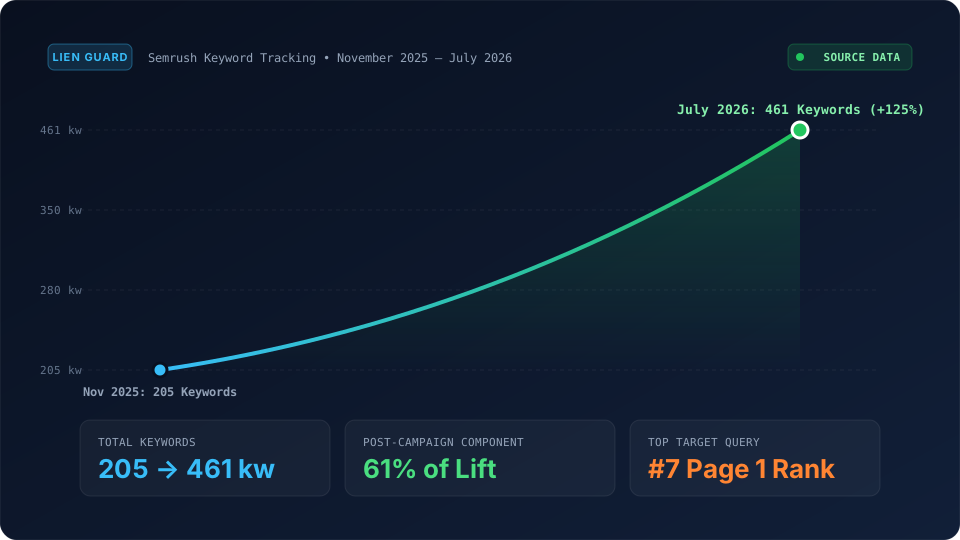
Lien Guard began the campaign ranking for205 keywords. By the time the six-month program ended in April, that had grown to304, a 48% increase, and a solid return on a fixed budget.
But the first quarter of the campaign looked like almost nothing was happening. November closed at 205. December, 209. January, 214, a gain of nine keywords across three months of work.
This is the point where most content programs get cancelled. Instead, the content kept maturing: February rose 14% to 243, March jumped another 28% to 312.
April was the only monthly pullback, down about 2.6% from March's 312. Beneath that dip, the strategy was still working. In May, rankings rose to350. In June they jumped another 24% to435. By July, Lien Guard ranked for461 keywords, roughly125% morethan when the campaign began.
From April to July alone, with no new pages being published, rankings grew another52%. Of the 256 total keywords gained,157 arrived after April. That means about61% of the growth happened after the six-month content campaign had already ended.
This wasn't volume piling up at the bottom of the results, either. Top-20 rankings grew from21 to 49, a 133% increase, so the added visibility landed where people actually look.
The campaign didn't only lift the new content. As the site's topical depth improved and the new resources linked into Lien Guard's core service pages, existing commercial and informational pages expanded their own footprints from their November 2025 baselines:
We won't claim every one of those gains traces exclusively to the six new pages, algorithm updates, competitor movement and other factors always contribute. But the pattern is consistent with what stronger internal linking and clearer topical authority tend to produce, and it's the reason we build contentintoa site rather than alongside it.
Page-Level Proof
Three pages created during the campaign are the clearest evidence. All three launched with no visibility at all.
Combined, those three pages went from0 rankings in November, to53 in April, to102 today, roughly22% of Lien Guard's entire ranking-keyword footprintfrom three pages that didn't exist a year ago.
"Essential Steps for Filing a Lien" is the clearest example of delayed growth. It held six rankings in March and April, dropped out of Semrush's top-100 dataset entirely in May, climbed to 24 in June, and now ranks for 46 keywords. Over that same stretch, Hold Harmless Agreements moved the other direction, from 24 in April to 16 today.
That's normal, and it's worth saying plainly: a temporary pullback doesn't mean the content failed, and one month is never a verdict. Pages settle, get re-evaluated, and settle again. What matters is the direction over quarters, not weeks.
A keyword count only means something if the positions are real. Current Semrush positions for these pages include:
Those are snapshots of current Semrush data, ranking examples, not guaranteed or permanent positions. They move. But they show the campaign earned front-page placement on terms a contractor with a payment problem would actually type.
- Conditional and Unconditional Lien Waivers, 0 → 23 (April) →40 today
- Hold Harmless Agreements, 0 → 24 (April) →16 today
- Essential Steps for Filing a Lien, 0 → 6 (April) →46 today
Why It Worked
The campaign worked because of what happened around the content, not just the content itself.
SEO does not operate on a monthly reset. When the research, the content, the technical execution and the site's internal relationships are right, the work keeps compounding after the active campaign ends. That's the whole argument for doing it properly the first time. It's the same pattern we saw when werebuilt and refreshed content for a web hosting provider.
- We picked opportunities, not keywords in a vacuum. Every topic had to be relevant to what Lien Guard actually sells and realistically winnable.
- One good page beat six thin ones.A monthly publishing cadence sounds modest until each page is built properly and aimed at a real question.
- Internal linking made the site make sense. New resources were wired into existing service pages, so Google could see the depth behind the subject, not six orphaned articles.
- We gave it time. Authority compounds. The steepest gains showed up months after the last page went live.
The content calendar ended in April. The results didn't. Six well-built pages, wired properly into an existing site, took Lien Guard from 205 ranking keywords to 461, and roughly 61% of that growth arrived after the last page was published. That's what a well-executedSEO and content programis supposed to do: keep paying out after the invoice stops.
Explore More
← Back to all case studies
What Could Six Months of Focused SEO Do for Your Business?
GetRanked builds content and SEO programs designed to produce lasting visibility, not a burst of disposable blog posts that stop working the moment the campaign ends.
Ready to achieve similar compounding search growth?
Request your private visibility brief. We'll audit your category keywords, identify unbranded ranking gaps, and map out highest-leverage growth moves.