
The Zero Marginal Value of Commodity Information
Between 2020 and 2024, digital marketing was flooded with automated content generation tools. Agencies and in-house teams mass-produced thousands of articles summarizing basic industry definitions, creating bloated 2,000-word guides that contributed zero original research, unique data, or operational insight.
In traditional search, this commodity content occasionally ranked through link velocity and topical volume. In generative search, however, generic content is entirely obsolete. Large language models already possess comprehensive baseline knowledge of standard industry definitions. When an answer engine synthesizes a response, it actively seeks original primary sources, specific empirical data, and verified practitioner experience to cite as evidence.
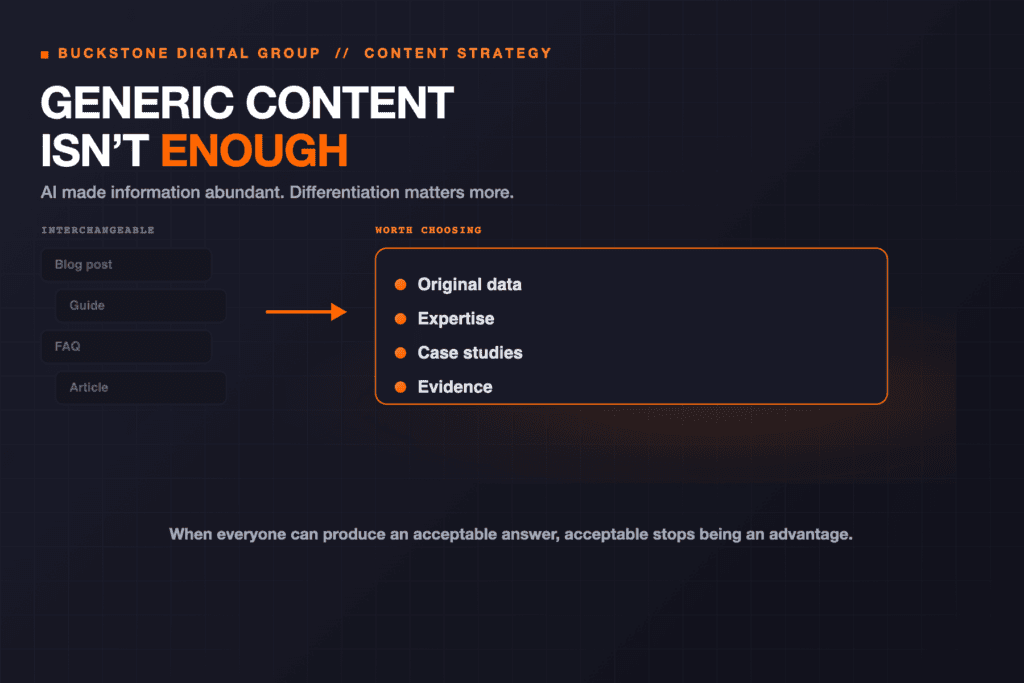
Comparison between commodity SEO content and high-density citation assets
Four Structural Failure Modes of Generic Copy
Understanding why answer engines bypass commodity articles requires analyzing the specific technical barriers they present to retrieval models.
| Failure Mode | What the Page Does | How the Retrieval Engine Reacts |
|---|---|---|
| Low Information Density | Fills paragraphs with obvious generalities ('In today's fast-paced digital world...') | Passage extraction algorithms assign low relevance scores and discard the chunk. |
| Zero Source Novelty | Paraphrases existing Wikipedia or high-ranking blog articles without new data | Information gain filters recognize identical semantic vectors and penalize distribution. |
| Absence of Empirical Evidence | Makes broad assertions without linking to methodologies, benchmarks, or case studies | Fact-checking consensus filters flag the statements as unverified marketing claims. |
| Structural Indirection | Buries practical answers beneath multi-paragraph historical introductions | Latency-constrained search bots fail to locate candidate answer blocks within query timeouts. |
The Anatomy of a Citable Content Asset
Content that earns consistent citations across ChatGPT, Perplexity, and Google AI Overviews possesses distinct structural and editorial characteristics.
It prioritizes original practitioner frameworks over textbook definitions. It publishes proprietary bench testing data, anonymized client metrics, step-by-step diagnostic workflows, and unambiguous comparison matrices.
- Begins with generic definitions: 'What is cloud computing? Cloud computing is...'
- Written from secondary research without firsthand operational experience
- Vague recommendations that advise readers to 'follow best practices'
- Formatted as continuous walls of text with decorative stock photos
- Begins with an immediate, definitive answer accompanied by a diagnostic framework
- Written by verified technical practitioners with published field credentials
- Specific, quantifiable operational benchmarks and configuration code
- Clean semantic HTML comparison tables, numbered sequences, and JSON-LD markup
How to Transform Existing Commodity Content
Revitalizing legacy content into high-authority citation assets requires applying an editorial transformation process.
Cut Introductory Fluff
Delete the first three paragraphs of generic scene-setting. Lead the article immediately with your primary finding or operational thesis.
Inject Proprietary Data
Add internal benchmarks, client project observations, or survey results that exist nowhere else on the public internet.
Convert Prose into Structured Tables
Identify narrative comparisons in your text and translate them into clean HTML tables comparing features, pricing, or failure modes.
Bind to Verified Authors
Attach comprehensive Person schema linking the author's byline to their LinkedIn profile, technical patents, and industry speaking engagements.
Frequently Asked Questions About Content Quality in AI Search
Practical guidance for content teams navigating AI search standards.
Key Questions & Insights
Yes, AI is highly effective for research synthesis, drafting outlines, and formatting data tables. However, the core insights, empirical data, professional judgment, and strategic perspectives must come from experienced human practitioners.
Shen Li
AuthorSenior Search & AI Visibility Strategist at GetRanked. Specializing in technical SEO, Answer Engine Optimization (AEO), entity architecture, and search performance.
Explore GetRanked Services
Turn what you just read into compounding organic visibility, qualified buyer traffic, and revenue growth.
SEO Services
Full-funnel technical SEO, structured content architecture, and authority building designed to capture non-branded search demand.
Local SEO
Google Business Profile optimization, localized entity clarity, and geo-targeted authority to dominate high-intent local queries.
AEO & AI Search Visibility
Structured entity optimization, authoritative citations, and prompt engineering so your brand is recommended by ChatGPT and Google AI Overviews.
Web Design & Development
High-speed, conversion-focused Next.js websites engineered for Core Web Vitals, semantic schema, and seamless buyer experiences.