
The Evolution from Rank to Retrieval
For twenty-five years, organic search marketing was defined by a single objective: ranking on page one of Google for specific keyword phrases. If your website occupied position one through three, you captured the majority of commercial search clicks.
Today, search interfaces are moving from directory listings to synthesized answer engines. Google AI Overviews, ChatGPT Search, Perplexity, and Microsoft Copilot provide immediate, direct answers to complex buyer queries, often without requiring the user to click through to an underlying website.
AI Search Visibility is the measure of how frequently, accurately, and prominently your company is cited, recommended, and surfaced within these synthesized answer engines. It represents the transition from keyword matching to entity retrieval.
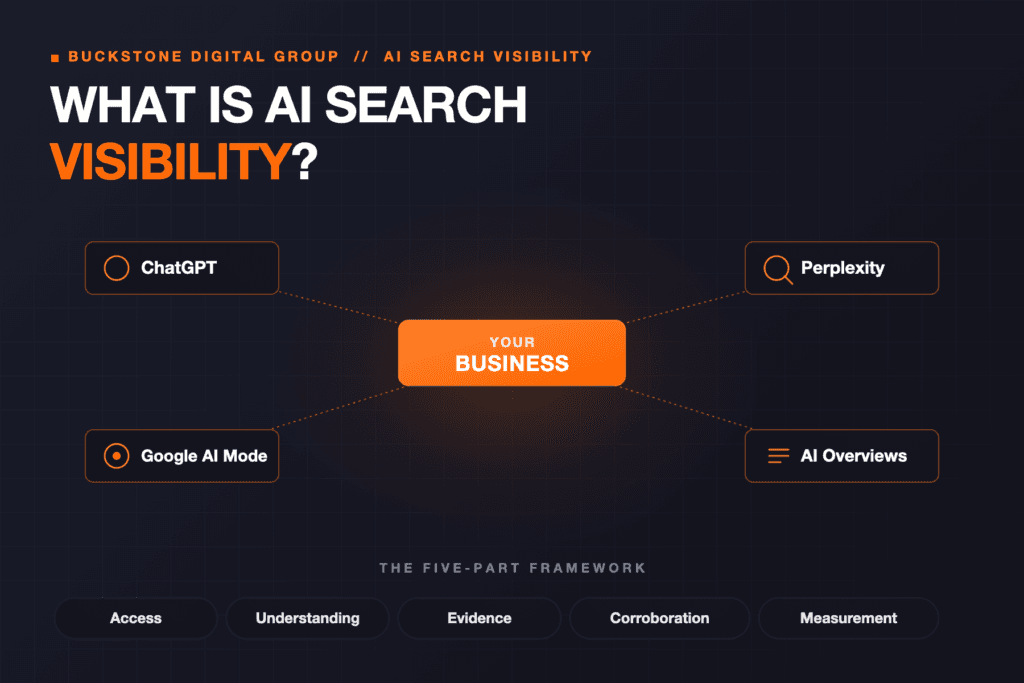
AI search visibility framework showing retrieval and entity architecture
Traditional SEO vs. AI Search Visibility
While AI search visibility builds upon strong organic search fundamentals, the mechanics of how content is selected and presented are fundamentally distinct.
| Dimension | Traditional SEO | AI Search Visibility (AEO) |
|---|---|---|
| Primary Metric | Keyword rank position (#1 through #10) | Citation presence, recommendation frequency, and sentiment |
| Output Format | List of discrete webpage links | Synthesized prose summary with embedded citation sources |
| Evaluation Engine | PageRank, keyword frequency, and link equity | Large Language Model retrieval, semantic grounding, and consensus |
| User Behavior | Scan titles, click multiple tabs, evaluate manually | Read synthesized answer, click only verified source citations |
| Content Architecture | Long-form content engineered for keyword density | High-density modular answers, structured tables, and clear entities |
How Answer Engines Select Their Sources
When an answer engine constructs a response, it follows a multi-stage retrieval architecture known as Retrieval-Augmented Generation (RAG). First, the engine expands the user's prompt into secondary search queries executed across traditional index databases.
Second, the engine extracts text chunks from top-ranking, accessible pages. Third, the language model filters these chunks for semantic relevance, factual accuracy, and consensus across multiple domains. Finally, it synthesizes the most authoritative information into the final answer and embeds attribution links.
Why Business Owners Cannot Ignore AI Search
The rise of zero-click searches means that traditional organic traffic metrics can decline even as your overall market presence grows, provided you are named in the synthesized answer. When an AI answer names your business as an industry leader, the prospective buyer receives immediate third-party validation that accelerates sales velocity.
Conversely, if your brand is absent from AI answers while competitors are highlighted, your company is systematically excluded from consideration during the crucial early research phase of the buyer journey.
- Preserving Brand Authority: Ensuring your company is named when prospects ask AI assistants for vendor comparisons.
- Capturing High-Intent Referral Clicks: Prospects who click citation links in AI answers have already been pre-qualified and convert at higher rates.
- Protecting Factual Accuracy: Ensuring AI models present correct pricing, capabilities, and geographic coverage rather than outdated or hallucinatory data.
- Future-Proofing Pipeline: Building entity authority that endures as conversational AI becomes the default interface for digital search.
Developing an AI Visibility Strategy
Achieving AI search visibility does not mean abandoning traditional SEO. It means evolving your technical and content systems so both search engine bots and AI retrieval models can access, understand, and trust your company.
Learn more about how GetRanked builds full-ecosystem visibility across Google Search, Google Maps, and AI answer engines by reviewing our comprehensive AI Search Visibility practice.
Key Questions & Insights
No. AI Search Visibility builds directly on top of traditional SEO. Large language models rely on search engine indexes (Google and Bing) to retrieve live web data for their answers. A site with poor technical SEO or weak domain authority will rarely be selected as a source by an AI answer engine.
Shen Li
AuthorSenior Search & AI Visibility Strategist at GetRanked. Specializing in technical SEO, Answer Engine Optimization (AEO), entity architecture, and search performance.
Explore GetRanked Services
Turn what you just read into compounding organic visibility, qualified buyer traffic, and revenue growth.
SEO Services
Full-funnel technical SEO, structured content architecture, and authority building designed to capture non-branded search demand.
Local SEO
Google Business Profile optimization, localized entity clarity, and geo-targeted authority to dominate high-intent local queries.
AEO & AI Search Visibility
Structured entity optimization, authoritative citations, and prompt engineering so your brand is recommended by ChatGPT and Google AI Overviews.
Web Design & Development
High-speed, conversion-focused Next.js websites engineered for Core Web Vitals, semantic schema, and seamless buyer experiences.