
The Technical Realities of Live Retrieval
When a user submits a complex prompt to an AI search engine, the system must execute query decomposition, live web retrieval, passage scoring, and language generation within two to three seconds. Under these rigorous computational constraints, search bots have zero tolerance for technical friction.
Websites with slow Time to First Byte (TTFB), bloated client-side JavaScript, unrenderable content, or broken internal link architectures are routinely bypassed during the retrieval window. Technical SEO is no longer just about passing Google's Core Web Vitals; it is the prerequisite for AI discoverability.
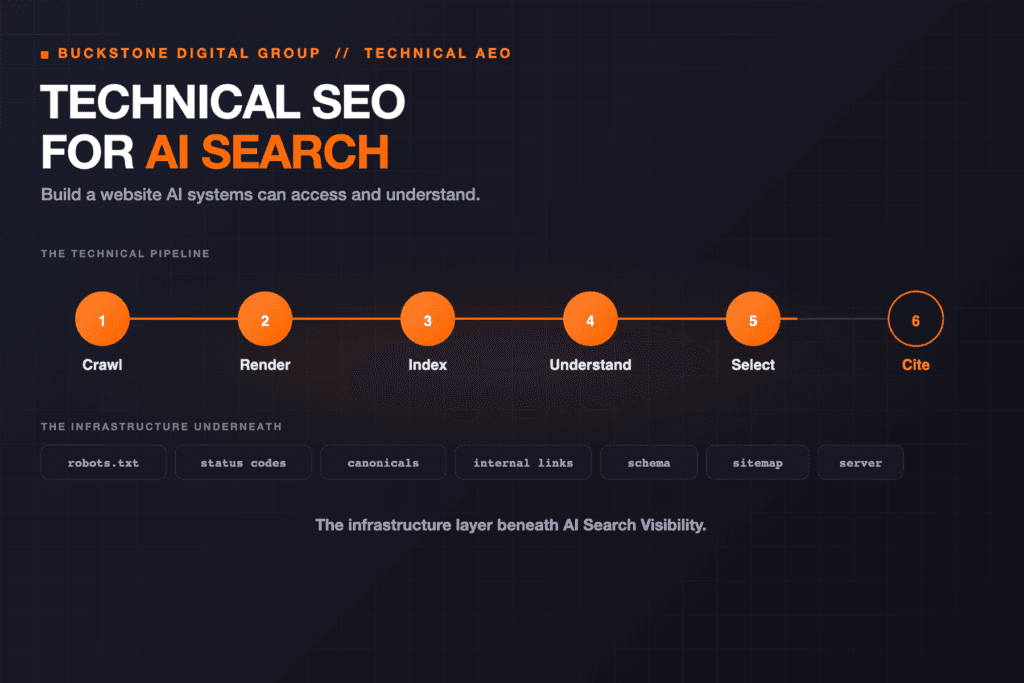
Technical SEO infrastructure for AI search engines
The Four Technical Pillars of AEO
Optimizing technical infrastructure for generative systems requires addressing four distinct engineering domains.
| Domain | Primary Challenge | Engineering Solution |
|---|---|---|
| Server Response Speed | High Time to First Byte (TTFB) causes crawler timeouts | Deploy edge caching via Cloudflare or Fastly; optimize database queries to ensure TTFB under 200ms. |
| HTML Rendering Mode | Heavy client-side JavaScript rendering fails on fast bot passes | Implement Server-Side Rendering (SSR) or Static Site Generation (SSG) to deliver complete HTML. |
| Crawler Access Control | Overly broad robots.txt disallows block discovery bots | Audit robots.txt and WAF rules to explicitly permit verified user agents like OAI-SearchBot. |
| Semantic Data Delivery | Unstructured copy requires heavy parsing computations | Deliver fully nested JSON-LD schema in the HTML document head with external knowledge graph links. |
Why Server-Side Rendering Is Non-Negotiable
While Googlebot maintains a secondary rendering queue capable of executing JavaScript, secondary rendering introduces significant indexing latency. More critically, newer AI crawlers like OAI-SearchBot and PerplexityBot operate lightweight retrieval stacks that do not consistently execute client-side JavaScript frameworks.
If your website relies on Single Page Applications (SPAs) built with client-side React, Angular, or Vue where content is populated via asynchronous API calls, AI crawlers often see only blank template shells. Migrating to server-rendered architectures (Next.js, Remix, Astro) ensures every bot receives full, semantic content immediately.
- Initial HTML contains empty root div and heavy JavaScript script bundles
- AI crawlers experience timeouts waiting for client-side API hydration
- Critical business data, pricing, and FAQs remain invisible in raw source code
- High computational cost increases bounce rates for human users
- Complete semantic HTML payload delivered on the initial server response
- Instantly parsable by all discovery bots within 200 milliseconds
- Full text, structured data, and navigation links available immediately
- Superior Core Web Vitals and lightning-fast human browsing experience
Technical AEO Deployment Checklist
Audit your domain against this engineering standard to verify technical compliance.
Edge CDN and Caching Configuration
Configure globally distributed edge caching to ensure international retrieval requests resolve in under 200 milliseconds.
Raw HTML Content Verification
Disable JavaScript in your browser and inspect your pages. Verify that all essential text, tables, and links render without errors.
Robots.txt & HTTP Header Validation
Check that robots.txt permits search-critical AI crawlers and verify that HTTP response headers do not include accidental 'X-Robots-Tag: noindex' flags.
Schema.org Syntax Verification
Validate JSON-LD markup across all key page templates using automated testing suites to prevent broken syntax from invalidating entity data.
Frequently Asked Questions About Technical SEO for AI
Technical considerations for enterprise infrastructure and generative search engines.
Key Questions & Insights
While some crawlers can execute JavaScript during scheduled background crawls, real-time retrieval bots operating on tight latency budgets prioritize raw HTML. Relying on client-side JavaScript execution creates severe risks of incomplete indexation or citation omission.
Shen Li
AuthorSenior Search & AI Visibility Strategist at GetRanked. Specializing in technical SEO, Answer Engine Optimization (AEO), entity architecture, and search performance.
Explore GetRanked Services
Turn what you just read into compounding organic visibility, qualified buyer traffic, and revenue growth.
SEO Services
Full-funnel technical SEO, structured content architecture, and authority building designed to capture non-branded search demand.
Local SEO
Google Business Profile optimization, localized entity clarity, and geo-targeted authority to dominate high-intent local queries.
AEO & AI Search Visibility
Structured entity optimization, authoritative citations, and prompt engineering so your brand is recommended by ChatGPT and Google AI Overviews.
Web Design & Development
High-speed, conversion-focused Next.js websites engineered for Core Web Vitals, semantic schema, and seamless buyer experiences.