
The Recurring Obituary of Organic Search
For over two decades, commentators have regularly declared the death of Search Engine Optimization. The advent of Google Panda, mobile-first indexing, featured snippets, and zero-click SERPs were all heralded as the end of organic discovery. Each time, search did not die; it evolved toward higher technical fidelity and greater user utility.
The current rise of conversational engines (ChatGPT, Perplexity, Claude) and Google AI Overviews represents a genuine structural shift. However, generative search engines do not operate in a vacuum. They rely on real-time web retrieval to gather facts, verify claims, and present authoritative citations. The practice of optimizing web assets for discovery has not disappeared. It has expanded into multi-surface entity optimization.
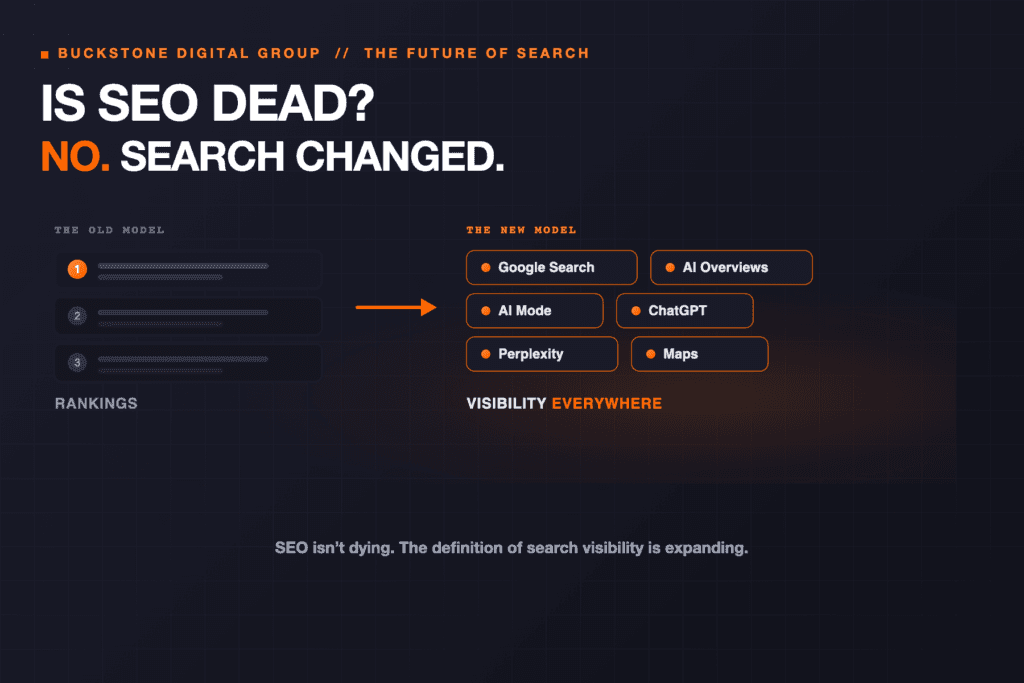
The evolution of search from keyword matching to AI discovery
The Three Phases of Search Evolution
Understanding the future of organic discovery requires recognizing how search mechanics transitioned across three distinct eras.
| Era | Primary Search Engine Mechanism | Dominant Optimization Strategy | Primary Metric |
|---|---|---|---|
| Phase 1: String Search (1998-2012) | Exact-match keyword indexing and raw PageRank link counts | Keyword density, meta keywords, reciprocal link directories | SERP Rank (Position 1 to 10) |
| Phase 2: Semantic Search (2013-2023) | Knowledge Graph entities, mobile UX, search intent clustering | Comprehensive topic clusters, schema markup, user experience | Organic Click-Through Rate & Traffic |
| Phase 3: Generative Discovery (2024+) | Vector embeddings, RAG pipelines, multi-surface citation synthesis | Entity corroboration, high-density practitioner copy, AEO | Citation Share of Voice & Qualified Pipeline |
What Still Works and What Must Be Abandoned
Modern marketing teams must separate obsolete legacy SEO tactics from the foundational disciplines that continue to drive compound pipeline growth.
- Generating hundreds of thin, programmatic blog posts targeting minor keyword variations
- Obsessing over exact-match anchor text and automated backlink outreach networks
- Treating meta descriptions as pure ranking factors rather than editorial click hooks
- Writing generic introductory fluff to artificially lengthen article word counts
- Publishing definitive, first-party industry data, benchmarks, and teardowns
- Building verified corporate entities across Wikidata, LinkedIn, and trade bodies
- Deploying pristine server-side rendered HTML with rigorous Schema.org markup
- Structuring answers for immediate extraction by conversational retrieval engines
Strategic Roadmap for the AI Search Era
To safeguard and scale your organic pipeline in this environment, focus your resources on four strategic initiatives.
Audit Crawler Ingestion Policies
Ensure your robots.txt and cloud firewalls do not block live search bots like OAI-SearchBot and PerplexityBot while managing training scrapers.
Consolidate Fragmented Content
Prune thin legacy blog posts and merge related articles into authoritative, definitive guides that demonstrate unquestioned topical depth.
Engineer Structured Knowledge Architecture
Implement nested JSON-LD schema across your organization, services, and key leadership profiles with verified sameAs authority links.
Expand Multi-Surface Corroboration
Earn consistent mentions, reviews, and citations across independent trade publications, specialized directories, and industry consensus forums.
Frequently Asked Questions About the Future of SEO
Key considerations for business leaders evaluating organic search investments.
Key Questions & Insights
No. While simple factual queries are increasingly answered directly within search interfaces, commercial, B2B, and high-consideration consumer research requires deep source verification. Websites providing definitive, credible primary research continue to capture high-converting referral visitors.
Shen Li
AuthorSenior Search & AI Visibility Strategist at GetRanked. Specializing in technical SEO, Answer Engine Optimization (AEO), entity architecture, and search performance.
Explore GetRanked Services
Turn what you just read into compounding organic visibility, qualified buyer traffic, and revenue growth.
SEO Services
Full-funnel technical SEO, structured content architecture, and authority building designed to capture non-branded search demand.
Local SEO
Google Business Profile optimization, localized entity clarity, and geo-targeted authority to dominate high-intent local queries.
AEO & AI Search Visibility
Structured entity optimization, authoritative citations, and prompt engineering so your brand is recommended by ChatGPT and Google AI Overviews.
Web Design & Development
High-speed, conversion-focused Next.js websites engineered for Core Web Vitals, semantic schema, and seamless buyer experiences.