
The Prime Real Estate in Modern Google Search
Google AI Overviews (formerly Search Generative Experience, or SGE) represent the most consequential interface transformation in Google's search history. For millions of informational, commercial, and technical queries, Google now displays a comprehensive, multi-source synthetic summary positioned above traditional organic rankings.
Crucially, AI Overviews do not simply present text; they prominently feature interactive source cards with favicons, page titles, and direct outbound links. Winning placement in these source cards generates significant brand visibility and captures high-intent organic clicks.
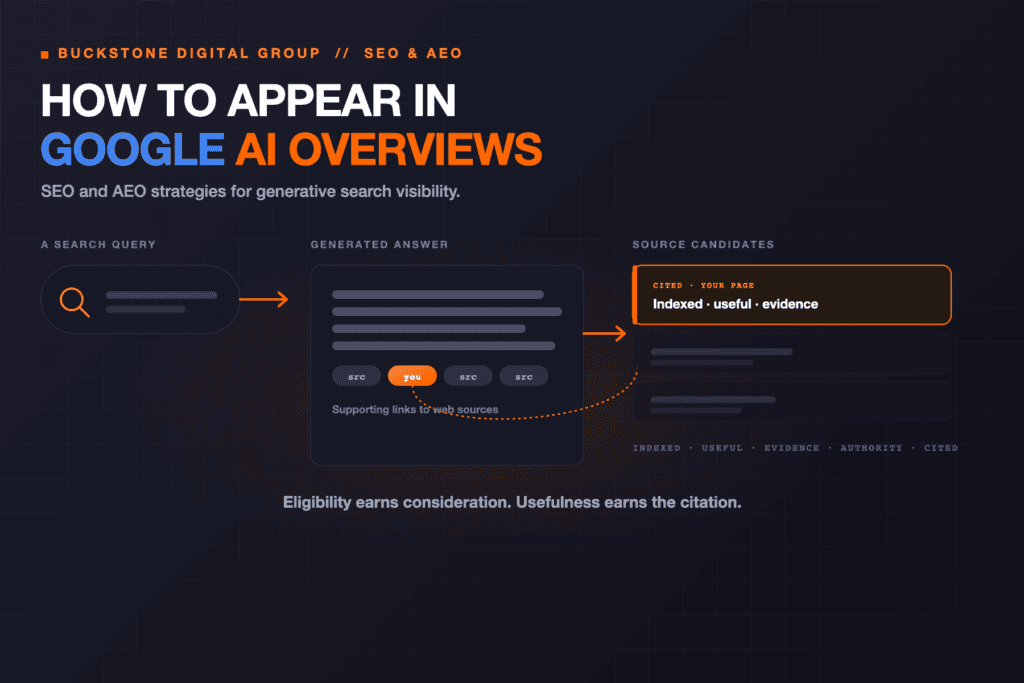
Google AI Overviews interface layout and citation cards
How Google Selects AI Overview Sources
Google's Gemini-powered retrieval pipeline evaluates potential sources through a multi-stage qualification filter.
| Funnel Stage | System Objective | Evaluation Metric |
|---|---|---|
| Initial Retrieval | Identify authoritative candidate documents | Standard organic ranking in top SERP positions (Positions 1 through 10) |
| Passage Extraction | Isolate candidate answers to query components | Information density and semantic concordance with user intent |
| Fact Verification | Cross-check claims against consensus data | Agreement with trusted reference entities and authoritative industry sources |
| Card Generation | Format primary source links for display | Domain trust, brand recognition, and page-level E-E-A-T signals |
The Four-Part AI Overview Optimization Framework
To position your web pages for regular inclusion in AI Overviews, apply this tactical optimization workflow.
Question-Targeted Section Architecture
Structure subheadings (H2 and H3) as explicit user questions or concise thematic queries that mirror actual search behavior.
Concise Definition Blocks
Provide a clean 40 to 60 word factual definition directly beneath each question heading, followed immediately by bulleted elaboration.
Tabular Comparison Formatting
Present comparative data, pricing models, or technical specifications in clean semantic HTML tables that AI models can extract intact.
Comprehensive Schema Validation
Equip the page with valid FAQPage and Article structured data to give Google's indexing parser explicit semantic markers.
Measuring Impact in Google Search Console
While Google Search Console does not currently separate AI Overview clicks into an isolated reporting filter, traffic and impressions from AI Overviews are aggregated within your standard Search Performance reports.
Pages that earn consistent AI Overview citations exhibit characteristic performance patterns: an elevated impression volume accompanied by higher average click-through rates on complex, multi-word conversational search queries.
Frequently Asked Questions About Google AI Overviews
Answers to common publisher and business questions regarding Google AI Overviews.
Key Questions & Insights
Google allows publishers to use the 'nosnippet' or 'data-nosnippet' robots directives to prevent text from being used in AI summaries. However, using these tags also restricts standard search snippets, which can severely reduce organic click-through rates across all Google results.
Shen Li
AuthorSenior Search & AI Visibility Strategist at GetRanked. Specializing in technical SEO, Answer Engine Optimization (AEO), entity architecture, and search performance.
Explore GetRanked Services
Turn what you just read into compounding organic visibility, qualified buyer traffic, and revenue growth.
SEO Services
Full-funnel technical SEO, structured content architecture, and authority building designed to capture non-branded search demand.
Local SEO
Google Business Profile optimization, localized entity clarity, and geo-targeted authority to dominate high-intent local queries.
AEO & AI Search Visibility
Structured entity optimization, authoritative citations, and prompt engineering so your brand is recommended by ChatGPT and Google AI Overviews.
Web Design & Development
High-speed, conversion-focused Next.js websites engineered for Core Web Vitals, semantic schema, and seamless buyer experiences.