
The Shift from String Matching to Semantic Understanding
For two decades, search engine optimization operated on textual matching: if a prospective buyer queried 'commercial HVAC repair in Chicago', search algorithms scanned index databases for pages containing those exact keywords in title tags, headings, and body paragraphs.
Generative search engines operate on an entirely different architecture. Rather than indexing isolated keywords, they translate digital text into multi-dimensional vector embeddings. In this vector space, concepts, businesses, and queries occupy geometric coordinates. An AI system determines relevance not by counting keyword repetitions, but by calculating semantic proximity between the user's intent and your brand's verified entity characteristics.
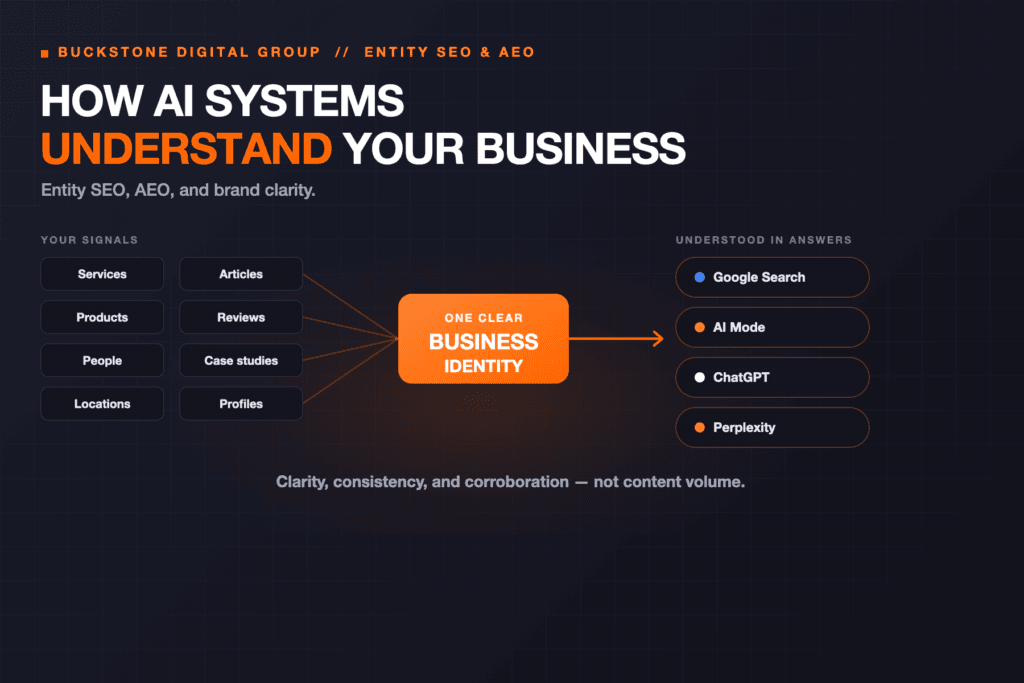
Vector embeddings and entity graph representation
The Three Pillars of AI Entity Comprehension
When a generative model evaluates whether to recommend your firm, it evaluates your digital presence through three distinct analytical lenses.
| Dimension | Primary Mechanism | How Your Business Is Evaluated |
|---|---|---|
| Vector Embeddings | Dense Mathematical Proximity | Evaluates topical authority by analyzing whether your content thoroughly addresses adjacent technical and operational subtopics. |
| Knowledge Graphs | Nodes and Relationships | Maps verified relationships between your company, leadership team, industry classifications, and physical operating locations. |
| Corroborative Consensus | Cross-Web Verification | Aggregates independent citations across trade journals, government records, client reviews, and press mentions to confirm factual claims. |
Retrieval-Augmented Generation (RAG) Explained
Understanding how ChatGPT, Perplexity, and Google AI Overviews cite websites requires understanding the RAG pipeline. Models do not hallucinate business recommendations from frozen training data; they execute real-time retrieval.
Prompt Expansion & Query Decomposition
The user prompt is expanded into multiple underlying factual queries targeting commercial parameters, locations, and vendor qualifications.
Live Web Index Retrieval
The engine queries its index (Google, Bing, or Perplexity's web index) and retrieves top-ranking web pages and structured entities.
Document Chunking & Semantic Reranking
Retrieved pages are broken into discrete text chunks and scored for factual relevance, informational density, and source trustworthiness.
Synthesis and Citation Generation
The highest-scoring chunks are passed into the model context window to generate the final synthesized answer, complete with linked citations.
Engineering Your Content for Semantic Comprehension
To ensure AI models understand and cite your organization, your digital publishing strategy must prioritize semantic clarity over promotional storytelling.
State your core value proposition directly in declarative sentences. Rather than writing 'We empower businesses to thrive in the modern era,' write 'We provide custom titanium CNC machining services for aerospace defense contractors certified under AS9100D.' Direct, factual statements provide the exact categorical grounding language models need to recommend your business.
Frequently Asked Questions About AI Entity Comprehension
Answers to frequent questions about vector embeddings, entity graphs, and search algorithms.
Key Questions & Insights
A keyword is a specific string of characters used in queries (e.g., 'commercial solar installers'). An entity is a well-defined object or concept in a knowledge graph (e.g., a specific commercial solar company with an address, founders, patents, and verified corporate registry). Search engines rank entities, not just web pages.
Shen Li
AuthorSenior Search & AI Visibility Strategist at GetRanked. Specializing in technical SEO, Answer Engine Optimization (AEO), entity architecture, and search performance.
Explore GetRanked Services
Turn what you just read into compounding organic visibility, qualified buyer traffic, and revenue growth.
SEO Services
Full-funnel technical SEO, structured content architecture, and authority building designed to capture non-branded search demand.
Local SEO
Google Business Profile optimization, localized entity clarity, and geo-targeted authority to dominate high-intent local queries.
AEO & AI Search Visibility
Structured entity optimization, authoritative citations, and prompt engineering so your brand is recommended by ChatGPT and Google AI Overviews.
Web Design & Development
High-speed, conversion-focused Next.js websites engineered for Core Web Vitals, semantic schema, and seamless buyer experiences.