
Why Language Models Rely on Structured Syntax
Large language models excel at processing natural language, but natural language is inherently ambiguous. When an agency website states, 'We partner with high-growth innovators across North America,' a human visitor recognizes marketing prose. A language model, however, cannot definitively determine whether the firm offers software development, investment banking, or recruiting services.
Structured data (Schema.org vocabulary encoded in JSON-LD) eliminates this ambiguity. By delivering semantic markup directly within the page header, you provide unambiguous metadata: exact legal names, specific service classifications, geographic footprints, executive leadership, and verified corporate identifiers.
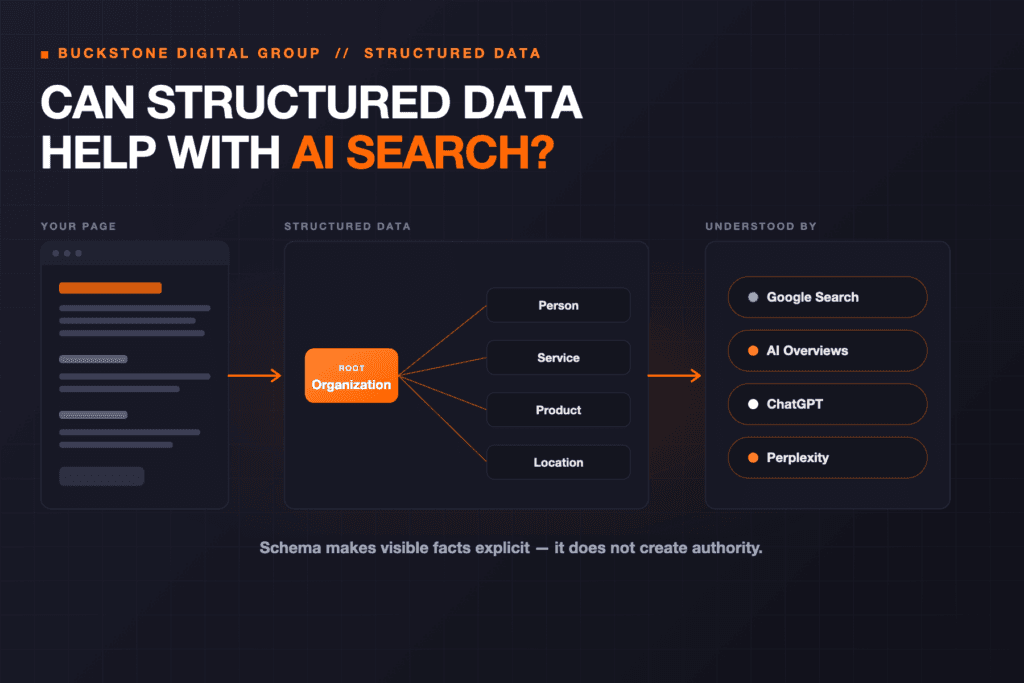
Structured data schema architecture for AI systems
High-Impact Schemas for AI Search Grounding
Implementing structured data for AI search visibility goes beyond basic article markup. The following schemas establish foundational entity credibility.
| Schema Type | Target Location | AI Visibility Function |
|---|---|---|
| Organization / Corporation | Homepage & About Page | Establishes entity identity, headquarters, official social profiles, and disambiguating Wikidata links. |
| Service / Product | Core Solution Pages | Defines exact service catalog, target audience (serviceType, areaServed), and commercial parameters. |
| FAQPage | Strategic Editorial Pages | Supplies direct question-and-answer pairs formatted for immediate extraction into AI answer blocks. |
| ProfilePage / Person | Author & Leadership Pages | Binds technical insights to verified human industry practitioners, reinforcing E-E-A-T signals. |
| LocalBusiness | Location Pages | Supplies precise geocoordinates, operating hours, accepted payment methods, and primary telephone contact. |
Entity Disambiguation via sameAs Connections
The most powerful, underutilized property in modern schema deployment is the 'sameAs' attribute within Organization markup. Search models use external knowledge graphs (such as Google Knowledge Graph, Wikidata, and Crunchbase) to verify business legitimacy.
When your schema links your domain to your Wikidata entity, LinkedIn organization profile, Crunchbase listing, and official state corporate registries, search engines consolidate fragmented brand mentions into a unified, high-confidence entity node.
- Generic WebPage schema generated automatically by CMS plugins
- No connection to external knowledge bases or verification registries
- Service descriptions that duplicate promotional marketing slogans
- Missing author Person entities on technical research articles
- Nested Organization and Corporation schemas with verified sameAs URLs
- Service entities containing explicit offers, audience, and areaServed
- FAQPage markup with direct, factual responses to commercial queries
- Full Person entities linking authors to LinkedIn and industry publications
Implementation and Validation Roadmap
Structured data must be syntactically valid and semantically truthful. Search engines penalize sites where schema claims contradict visible page content.
Entity Mapping & Vocabulary Selection
Map all core corporate assets, services, and team leaders to specific Schema.org classes and properties.
JSON-LD Script Generation
Draft clean, modular JSON-LD blocks placed directly in the HTML document head, avoiding dynamic client-side injection delays.
Rich Results & Schema Validator Testing
Validate syntax across both Google's Rich Results Test and the Schema.org Validator to resolve syntax errors, missing required fields, or unclosed brackets.
Content Concordance Audit
Ensure every data point declared in JSON-LD (pricing, addresses, names, deliverables) matches the human-readable text on the page identically.
Frequently Asked Questions About Structured Data for AI
Common questions regarding JSON-LD implementation and AI search citations.
Key Questions & Insights
No single signal guarantees placement. However, structured data significantly reduces algorithmic ambiguity, ensuring that when search models evaluate your domain during live retrieval, your core services and qualifications are parsed correctly without misinterpretation.
Shen Li
AuthorSenior Search & AI Visibility Strategist at GetRanked. Specializing in technical SEO, Answer Engine Optimization (AEO), entity architecture, and search performance.
Explore GetRanked Services
Turn what you just read into compounding organic visibility, qualified buyer traffic, and revenue growth.
SEO Services
Full-funnel technical SEO, structured content architecture, and authority building designed to capture non-branded search demand.
Local SEO
Google Business Profile optimization, localized entity clarity, and geo-targeted authority to dominate high-intent local queries.
AEO & AI Search Visibility
Structured entity optimization, authoritative citations, and prompt engineering so your brand is recommended by ChatGPT and Google AI Overviews.
Web Design & Development
High-speed, conversion-focused Next.js websites engineered for Core Web Vitals, semantic schema, and seamless buyer experiences.