
Two Paradigms of Search Discovery
For twenty years, digital marketing teams played by a clear set of rules: research keyword volume, optimize on-page title tags and headings, build external hyperlinks, and climb Google's ten blue links. Success was measured in keyword ranking positions and organic sessions.
Today, a parallel search ecosystem has emerged. Platforms like ChatGPT Search, Perplexity AI, Claude, and Google AI Overviews do not simply organize links. They synthesize complete answers in real time, selecting only a handful of trusted web sources to substantiate their output. Understanding the technical and strategic differences between Traditional SEO and AI SEO is essential for modern marketing leaders.
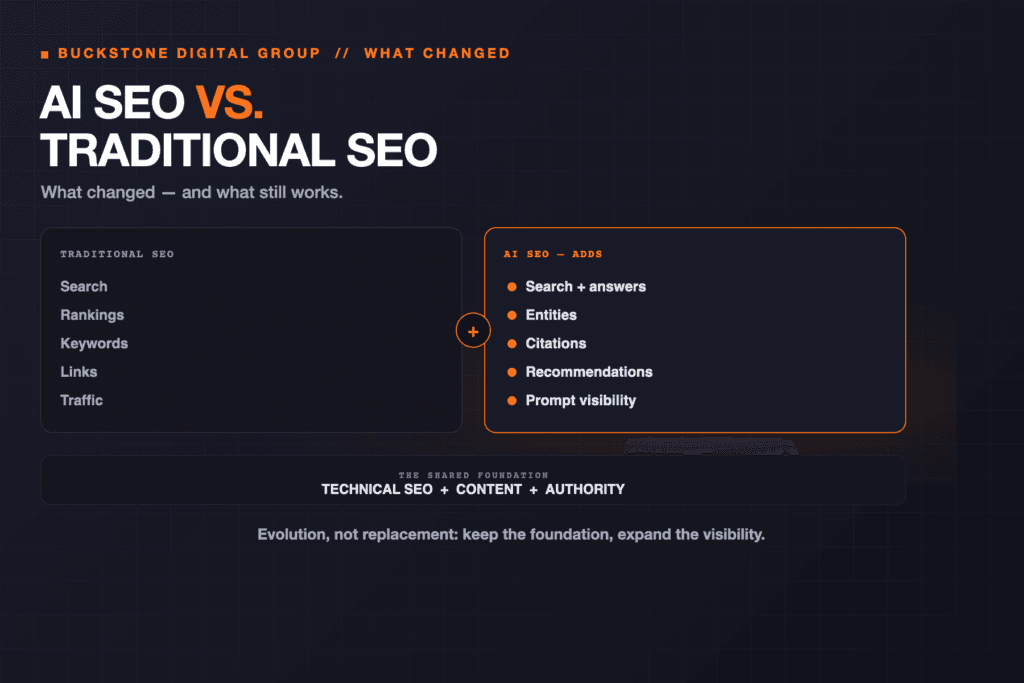
Architectural comparison between Traditional SEO and AI Search Optimization
Direct Comparison: Traditional SEO vs. AI SEO
This side-by-side operational matrix contrasts how search discovery functions across both environments.
| Dimension | Traditional SEO | AI SEO / AEO |
|---|---|---|
| Primary Goal | Rank within top 10 organic SERP positions | Earn direct citations and brand recommendations in generated answers |
| Target Query Type | Discrete, fixed-keyword phrases (2 to 4 words) | Conversational, multifaceted natural language prompts |
| Retrieval Mechanism | Inverted index lookup based on textual matching and PageRank | Dense vector embedding search, semantic reranking, and RAG pipelines |
| Content Structure | Comprehensive long-form pages with keyword distribution | High-density, answer-first modular sections with clean tables |
| Authority Signals | Domain Rating, raw backlink volume, and anchor text distribution | Cross-web entity consensus, specialized trade citations, and verified schemas |
| Primary Success Metrics | Rank position, organic impressions, raw sessions | Citation share of voice, brand inclusion rate, high-intent pipeline |
Where Optimization Strategy Diverges
The most substantial divergence lies in how content is consumed by the indexing system.
In Traditional SEO, search spiders crawl the entire HTML document to gauge overall topical focus. In AI SEO, retrieval systems extract discrete 200 to 400-word passages ('chunks') to pass into language model context windows. If your core insight is buried beneath paragraphs of throat-clearing fluff, the retrieval chunker assigns it a low relevance score and discards it.
- Writing 2,500-word blog posts to maximize total keyword variations
- Using clever, metaphorical headings that obscure practical section topics
- Hiding answers midway through the article to increase dwell time metrics
- Relying on generic stock images and decorative infographics
- Modular sections led by 40-word declarative answer definitions
- Explicit, question-based headings that mirror real conversational prompts
- Clean HTML tables comparing specifications, pricing, and operating bounds
- Structured JSON-LD schema providing unambiguous entity metadata
Building a Unified Organic Growth Engine
Rather than managing separate campaigns for Google and conversational AI engines, forward-thinking organizations deploy a unified architecture that serves both discovery channels simultaneously.
Establish Technical Foundation
Ensure server-rendered HTML payloads, sub-200ms TTFB, and unhindered crawler access for both traditional and AI user agents.
Implement Entity Schemas
Deploy deep Organization, Service, and FAQPage JSON-LD schemas linking your domain to external knowledge graph registries.
Publish Answer-First Content
Structure all commercial and educational content so that primary definitions and frameworks appear immediately beneath headings.
Cultivate External Corroboration
Secure authoritative mentions and reviews across industry databases, partner ecosystems, and verified third-party review platforms.
Frequently Asked Questions About AI SEO
Common questions from digital marketing practitioners and business operators.
Key Questions & Insights
Extremely rarely. Language model retrieval engines rely heavily on traditional search indexes (Google and Bing) to populate their real-time candidate document pools. If your site has zero traditional SEO visibility, AI retrieval bots will rarely encounter your content.
Shen Li
AuthorSenior Search & AI Visibility Strategist at GetRanked. Specializing in technical SEO, Answer Engine Optimization (AEO), entity architecture, and search performance.
Explore GetRanked Services
Turn what you just read into compounding organic visibility, qualified buyer traffic, and revenue growth.
SEO Services
Full-funnel technical SEO, structured content architecture, and authority building designed to capture non-branded search demand.
Local SEO
Google Business Profile optimization, localized entity clarity, and geo-targeted authority to dominate high-intent local queries.
AEO & AI Search Visibility
Structured entity optimization, authoritative citations, and prompt engineering so your brand is recommended by ChatGPT and Google AI Overviews.
Web Design & Development
High-speed, conversion-focused Next.js websites engineered for Core Web Vitals, semantic schema, and seamless buyer experiences.