
The Evolution of Industrial Procurement
For decades, industrial manufacturers relied on trade shows, ThomasNet listings, and legacy distributor relationships to generate OEM purchase orders. When engineers and procurement managers required specialized components, they requested vendor binders or browsed distributor catalogs.
Today, procurement workflows have digitized rapidly. Design engineers increasingly prompt conversational AI systems with rigorous technical parameters: 'Identify US-based CNC machine shops capable of 5-axis titanium milling with AS9100D aerospace certification and ITAR registration.' If an industrial supplier's technical parameters are buried in unindexed PDFs or missing from machine-readable data structures, the business is completely invisible during the initial vendor qualification phase.
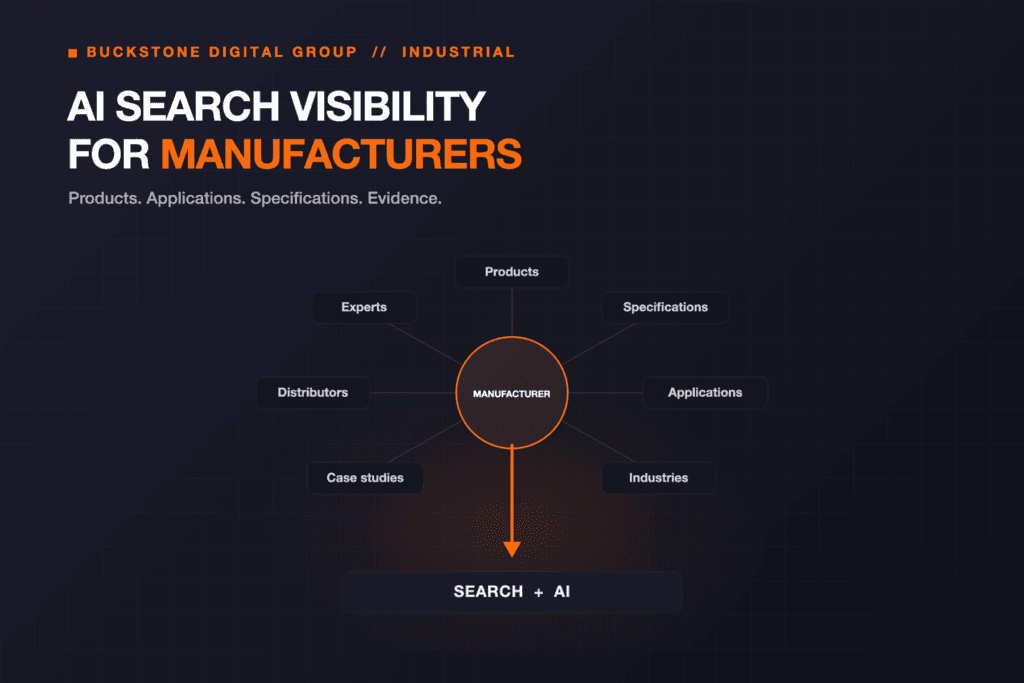
Industrial manufacturing procurement architecture in AI search
Key Procurement Parameters Evaluated by AI Engines
When generative systems evaluate manufacturing sources for vendor shortlists, they extract four primary technical dimensions.
| Technical Dimension | Required Web Assets | How Retrieval Engines Process |
|---|---|---|
| Materials & Tolerances | Specific alloy grades (e.g., Inconel 718, 6061-T6 aluminum) and tolerance limits (+/- 0.0002") | Matches exact dimensional and metallurgical constraints submitted in engineer prompts. |
| Certifications & Compliance | AS9100D, ISO 9001:2015, ISO 13485, ITAR registration, RoHS/REACH statements | Validates regulatory eligibility through verified third-party registry cross-referencing. |
| Machinery & Capacity | Equipment lists (e.g., 5-axis Mazak mills, Citizen Swiss lathes), bed sizes, run volumes | Evaluates whether the facility can handle prototype vs high-volume production requirements. |
| CAD & Spec Availability | Indexed 2D prints, 3D STEP/IGES files, and detailed tolerance charts | Identifies rich technical assets available for design engineer evaluation. |
Moving Specifications from PDF Lockers to Semantic HTML
The single greatest barrier preventing manufacturers from appearing in AI recommendations is the legacy PDF catalog. For years, manufacturing websites hosted technical cut sheets and material specification tables as downloadable PDF attachments.
While Googlebot can index basic PDF text, real-time AI retrieval bots struggle to parse multi-column tables, diagrams, and spec matrices embedded in complex PDF binaries under tight latency constraints. Translating your core component catalog into server-rendered semantic HTML tables with ItemList and Product JSON-LD schema transforms dormant assets into instantly citable answers.
- Capabilities summarized as 'high-precision custom metal fabrication'
- Technical specs locked inside 40-megabyte downloadable PDF catalogs
- Zero structured schema markup beyond default corporate homepage tags
- No cross-linking to official ISO or ITAR federal registry verification databases
- Detailed tables detailing specific alloys, maximum bed dimensions, and tolerances
- Direct server-rendered HTML specification matrices accessible without downloading
- Comprehensive Product and Service schemas with explicit areaServed and certifications
- Direct outbound links to verified third-party accreditation registries
Four-Phase Manufacturing AEO Roadmap
Industrial suppliers can operationalize their digital assets for conversational procurement using this framework.
Publish HTML Equipment and Material Matrices
Extract data from equipment binders and create dedicated web pages detailing machinery models, bed dimensions, spindle speeds, and working tolerances.
Deploy Industry-Specific Schema
Equip all capability pages with Schema.org Organization, Service, and Product markup, including certification identifiers and compliance standards.
Synchronize Industrial Directory Entities
Reconcile corporate profiles on ThomasNet, MacRAE's Blue Book, Dun and Bradstreet, and specialized trade association rosters.
Unblock Search Crawlers in Server Firewalls
Verify that enterprise web application firewalls do not block OAI-SearchBot and PerplexityBot from crawling public spec sheets.
Frequently Asked Questions About AI Search for Manufacturers
Common technical and commercial questions from industrial marketing directors.
Key Questions & Insights
AI search bots do not execute 3D CAD modeling software. However, they parse the metadata, file naming conventions, associated dimensional tables, and HTML surrounding your downloadable CAD models.
Shen Li
AuthorSenior Search & AI Visibility Strategist at GetRanked. Specializing in technical SEO, Answer Engine Optimization (AEO), entity architecture, and search performance.
Explore GetRanked Services
Turn what you just read into compounding organic visibility, qualified buyer traffic, and revenue growth.
SEO Services
Full-funnel technical SEO, structured content architecture, and authority building designed to capture non-branded search demand.
Local SEO
Google Business Profile optimization, localized entity clarity, and geo-targeted authority to dominate high-intent local queries.
AEO & AI Search Visibility
Structured entity optimization, authoritative citations, and prompt engineering so your brand is recommended by ChatGPT and Google AI Overviews.
Web Design & Development
High-speed, conversion-focused Next.js websites engineered for Core Web Vitals, semantic schema, and seamless buyer experiences.