
The Attribution Blind Spot in Modern Marketing
As prospective buyers increasingly use ChatGPT, Perplexity, Claude, and Google AI Overviews to evaluate vendors, marketing executives face a critical reporting challenge: where does this revenue appear in standard analytics dashboards?
In many organizations, traffic originating from AI answer engines is miscategorized as generic 'Direct' traffic or lumped into broad referral buckets. When business leaders cannot accurately attribute revenue to generative search discovery, budgets are misallocated toward declining legacy channels. Proving the commercial return of AEO requires building a rigorous attribution and reporting architecture.
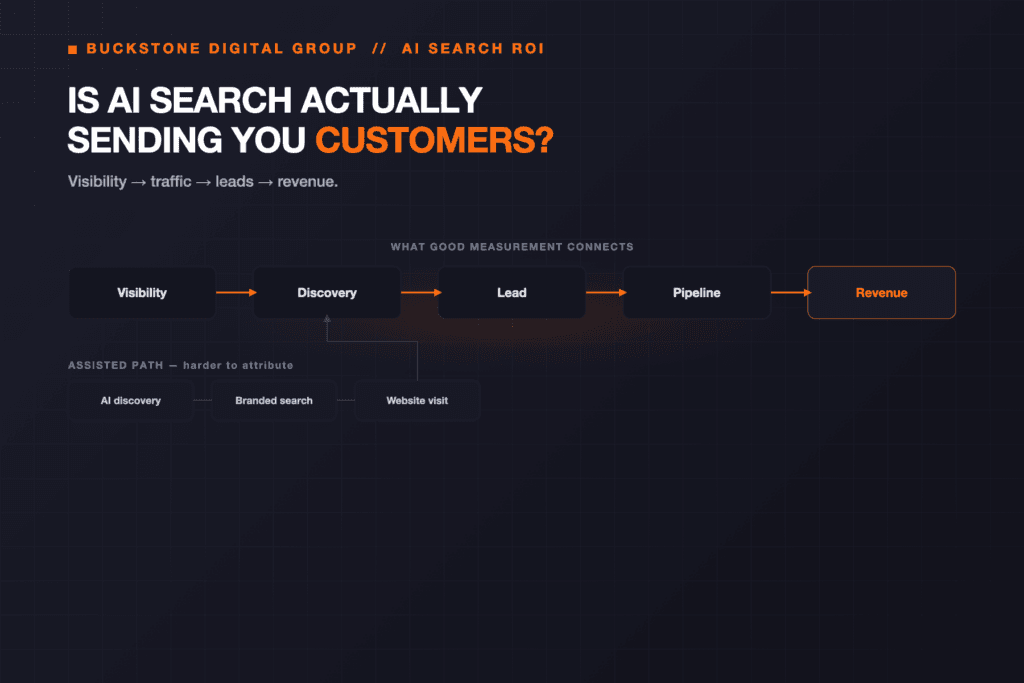
Attribution model and ROI tracking framework for AI search referral traffic
The Four Commercial Dimensions of AI Search ROI
Evaluating the financial return of an AEO program requires measuring impact across four distinct commercial metrics.
| ROI Pillar | Primary KPI | Measurement Method |
|---|---|---|
| High-Intent Referral Revenue | Closed-Won Pipeline from AI Citations | Isolate referrals from chatgpt.com, perplexity.ai, and claude.ai in GA4 and CRM. |
| Reduced Customer Acquisition Cost | Blended CAC Reduction (%) | Compare organic AI customer acquisition costs against expensive PPC paid search benchmarks. |
| Brand Citation Share of Voice | Generative SOV vs. Named Competitors | Sample commercial prompt matrices weekly across generative engines to track inclusion. |
| Defensive Brand Protection | Correction of Hallucinated Misinformation | Eliminate lost pipeline caused by outdated pricing or erroneous service discontinuation claims. |
Configuring GA4 for Clean AI Referral Attribution
Standard Google Analytics 4 installations fail to categorize conversational engines properly out of the box. By default, referrals from chatgpt.com or perplexity.ai are mixed into general 'Referral' traffic alongside random blogs and spam domains.
To establish clear attribution, configure a custom Channel Grouping in GA4 named 'AI Search Engines'. Define rule conditions matching Source regex patterns for chatgpt\.com, perplexity\.ai, claude\.ai, and copilot\.microsoft\.com. This provides leadership with an immediate, high-level view of AI traffic volume, session duration, and goal completions.
- AI traffic lost inside generic Referral or Direct traffic buckets
- Zero visibility into which specific commercial prompts drove the visit
- Unable to prove pipeline contribution to executive leadership
- Budgets remain tied to legacy keyword ranking reports
- Dedicated 'AI Search Engines' custom channel grouping in GA4
- CRM lead forms equipped with self-reported attribution ('How did you hear about us?')
- Direct pipeline and revenue tracking mapped to AI referral source paths
- Executive dashboards reporting monthly Citation Share of Voice and ROI
Four Steps to Operationalize AI ROI Reporting
Marketing and revenue operations teams should implement this measurement protocol.
Configure GA4 Custom Channel Grouping
Create a dedicated channel grouping isolating ChatGPT, Perplexity, Claude, and Copilot referral traffic.
Deploy Self-Reported Attribution Fields
Add an open-text 'How did you first hear about us?' field to your primary lead capture forms to capture buyers who researched via AI before visiting directly.
Map CRM Lead Sources to Opportunities
Tag incoming leads with their first-touch and last-touch referral sources in your CRM (Salesforce, HubSpot) to track closed-won revenue.
Publish Monthly Generative SOV Reports
Present an executive summary tracking citation share of voice, referral traffic growth, and attributed pipeline against target competitors.
Frequently Asked Questions About AI Search ROI
Practical guidance for CFOs, CMOs, and revenue operations leaders.
Key Questions & Insights
AI search engines prioritize quality over volume. While traditional search serves millions of quick exploratory clicks, AI search pre-summarizes answers, sending fewer total visits but dramatically higher-intent buyers who are ready to engage or purchase.
Shen Li
AuthorSenior Search & AI Visibility Strategist at GetRanked. Specializing in technical SEO, Answer Engine Optimization (AEO), entity architecture, and search performance.
Explore GetRanked Services
Turn what you just read into compounding organic visibility, qualified buyer traffic, and revenue growth.
SEO Services
Full-funnel technical SEO, structured content architecture, and authority building designed to capture non-branded search demand.
Local SEO
Google Business Profile optimization, localized entity clarity, and geo-targeted authority to dominate high-intent local queries.
AEO & AI Search Visibility
Structured entity optimization, authoritative citations, and prompt engineering so your brand is recommended by ChatGPT and Google AI Overviews.
Web Design & Development
High-speed, conversion-focused Next.js websites engineered for Core Web Vitals, semantic schema, and seamless buyer experiences.