
The Breakdown of the Static Ranking Paradigm
For two decades, search marketing reporting was straightforward: choose a list of 100 keywords, track daily position changes on Google's desktop and mobile result pages, and celebrate when your URL moved from position 4 to position 1.
In generative search, static rankings do not exist. When a user submits a prompt to ChatGPT Search, Perplexity, or Google AI Overviews, the output is generated probabilistically based on dynamic retrieval, model temperatures, user conversational context, and geographic location. Two users querying the same commercial need thirty seconds apart may receive synthesized answers citing completely different sources. Measuring success requires an entirely new analytical framework.
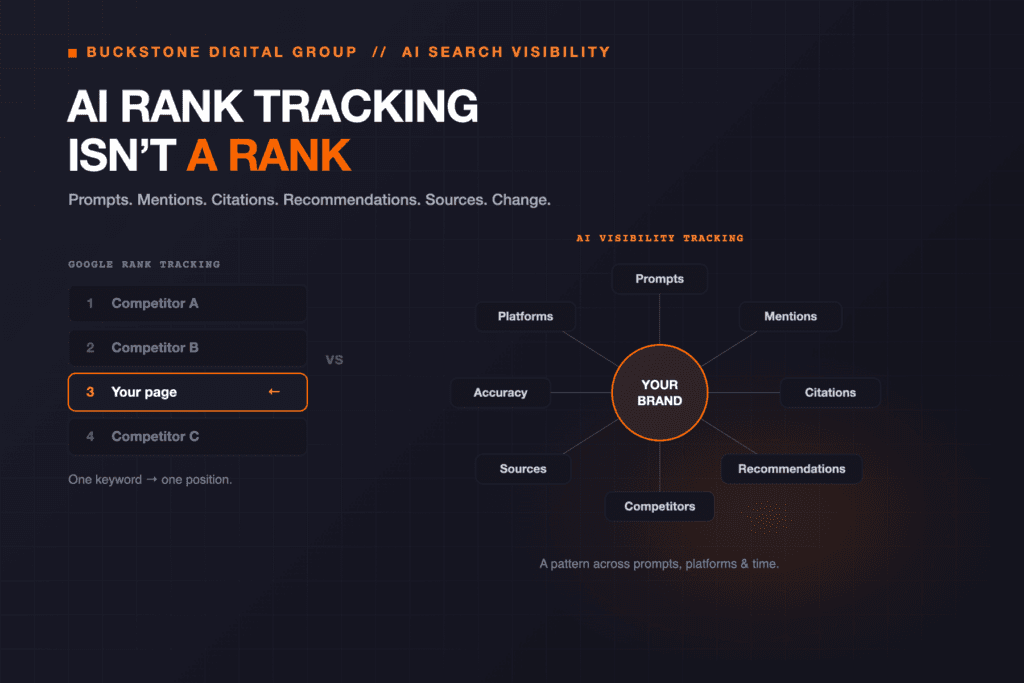
Measurement comparison between static SERP tracking and generative share of voice
Comparing Measurement Frameworks
Review this breakdown to understand how performance metrics transition from deterministic SERPs to conversational AI models.
| Traditional Metric | What It Measures | Modern AI Equivalent | Why the AI Metric Matters |
|---|---|---|---|
| Keyword Rank Position | Specific numeric slot on the SERP (1 to 100) | Citation Inclusion Rate (%) | Measures the percentage of prompt executions where your brand is cited as a source. |
| Search Impressions | How many times your snippet was loaded on screen | Generative Share of Voice (SOV) | Measures your brand's citation frequency relative to named competitors across a category. |
| Click-Through Rate (CTR) | Percentage of impressions resulting in a web visit | Referral Click-Through Quality | Tracks user engagement from high-intent buyers who read an AI summary before clicking. |
| Organic Keyword Count | Total number of keywords for which the site ranks | Entity Topical Breadth | Evaluates the breadth of related industry concepts and subtopics associated with your entity. |
How to Build an AI Visibility Tracking Program
Measuring your company's generative presence requires implementing a programmatic sampling methodology.
Rather than checking a single static keyword, formulate a comprehensive prompt matrix representing realistic buyer scenarios across early research, vendor evaluation, and commercial procurement stages. Sample these prompts across ChatGPT, Perplexity, Claude, and Gemini on a weekly cadence to calculate statistical inclusion rates and monitor competitor displacement.
- Tracking exact 3-word keyword strings ('commercial lawyer chicago')
- Reporting single daily ranking numbers without context
- Focusing exclusively on Google desktop and mobile SERPs
- Measuring success primarily through raw gross organic traffic volume
- Tracking multi-sentence conversational buyer prompts and follow-up queries
- Sampling prompts across multiple runs to calculate statistical citation probability
- Monitoring presence across ChatGPT Search, Perplexity, Claude, and Google AI Overviews
- Measuring qualified pipeline, brand sentiment, and referral conversion rates
Step-by-Step Reporting Implementation
Establish an enterprise AI visibility reporting cadence following these operational steps.
Construct Buyer Prompt Taxonomy
Develop 30 to 50 realistic conversational prompts covering informational, comparative, and vendor selection phases in your industry.
Establish Automated Sampling
Utilize modern AEO tracking platforms or custom API scripts to execute prompts weekly across all major generative engines.
Tag AI Referral Traffic in Analytics
Configure custom channel grouping in Google Analytics to isolate referral traffic from chatgpt.com, perplexity.ai, and claude.ai.
Correlate Visibility with Pipeline
Track whether prospective buyers originating from AI referral sources exhibit higher qualified lead velocity and conversion rates.
Frequently Asked Questions About AI Rank Tracking
Practical guidance on tracking tools, analytics setups, and executive reporting.
Key Questions & Insights
Legacy SEO platforms track whether your URLs appear in Google AI Overviews on standard SERPs. However, tracking conversational citations across standalone platforms like ChatGPT Search and Perplexity requires specialized AEO tracking tools or custom API monitoring scripts.
Shen Li
AuthorSenior Search & AI Visibility Strategist at GetRanked. Specializing in technical SEO, Answer Engine Optimization (AEO), entity architecture, and search performance.
Explore GetRanked Services
Turn what you just read into compounding organic visibility, qualified buyer traffic, and revenue growth.
SEO Services
Full-funnel technical SEO, structured content architecture, and authority building designed to capture non-branded search demand.
Local SEO
Google Business Profile optimization, localized entity clarity, and geo-targeted authority to dominate high-intent local queries.
AEO & AI Search Visibility
Structured entity optimization, authoritative citations, and prompt engineering so your brand is recommended by ChatGPT and Google AI Overviews.
Web Design & Development
High-speed, conversion-focused Next.js websites engineered for Core Web Vitals, semantic schema, and seamless buyer experiences.